How Window Tinting Reduces Interior Heat and UV Exposure
Tint works on the sunlight at the glass, so less of it ends up cooking your dashboard and seats.
October 16, 2026 · 4 min read
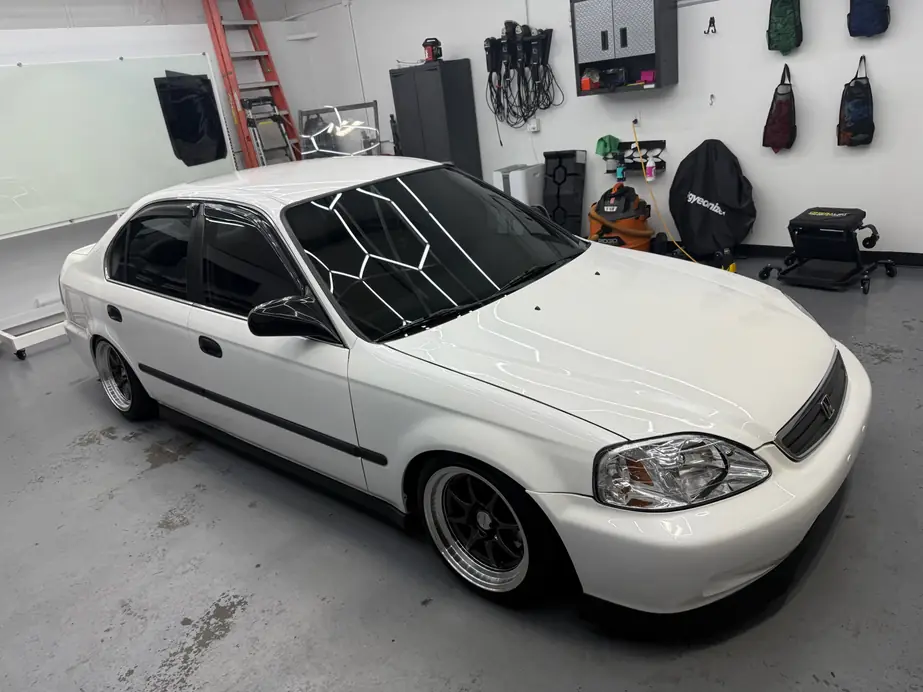
Open the door of a car that has been parked outside in Winter Springs in July and the heat hits like an oven. A good part of that heat arrives through the glass. Window tint is one of the few upgrades that goes after it at the source. Here is how it works, in plain terms, and what to expect from different films.
Where the heat comes from
Sunlight reaches the car as three kinds of energy: visible light you can see, ultraviolet (UV) you cannot, and infrared, which you feel as heat. Plain glass lets a lot of that through. Dark surfaces inside, like the dashboard, seats and steering wheel, absorb it and give it back off as heat. That is why a closed car in a parking lot keeps getting hotter than the air outside.
What tint film does to it
Window film sits on the glass and changes what passes through. Depending on how it is made, it absorbs some of the solar energy, reflects some, or does both, so less of it reaches the interior. Film aimed at heat is mostly working on the infrared part. Film aimed at UV is working on the part that damages materials and skin. Better films handle both, and that is where the difference between film types shows up.
Carbon versus ceramic
DDM Services installs Union window tint in both types. Carbon film has a deep, non-fading finish with solid heat and glare reduction. Ceramic film uses nano-ceramic technology for higher heat rejection and improved clarity, and it does not interfere with phone, GPS or radio signals.
Dark and effective are not the same thing. A lighter ceramic film can handle heat better than a darker film of a lesser type, which is why shade alone is a poor way to shop. Ask what the film is made of, not only how dark it looks. If you are choosing between carbon and ceramic, our starting prices on the window tint page make the step up easy to see.
What it means for the inside of your car
UV is what fades dashboards, bleaches seats and dries out leather and trim over the years. Less sunlight reaching those surfaces slows that wear. The cabin also warms more slowly on a hot day, so the car feels comfortable sooner and the air conditioning does not have to fight as hard. Film cannot make a parked car cold, but it changes how hot things get. On a commute with the sun low through the side glass, or a school run in a car that sat in a lot all day, that difference is the one you feel first. Owners tend to report the same handful of things:
- Seats and steering wheel that are less painful to touch after parking outside.
- Less squinting at low sun, since film also cuts glare.
- An interior that holds its color and texture longer.
- More privacy, because it is harder to see in from outside.
- Less direct sun on arms and legs through the side windows.
Windshield and sunstrip
Side and rear glass are what most people think of, but the windshield is the largest piece of glass and takes the most direct sun. We offer ceramic film for the windshield at $325 on its own or $225 when it is done with another package, and a sunstrip across the top from $75. Windshield film is chosen for clarity and heat performance, since you have to see through it, not for a dark look.
Florida sets limits on tint by window and vehicle type, and we go through them with you before any film is cut. That keeps the car comfortable and legal, and it means no surprises later.
Why the install matters as much as the film
Even the best film performs poorly if the install is sloppy. Dust under the film, a misaligned edge or a bubble all show up in the finished window. Our process has three steps: cleaning and prep, application with precision computer-cut patterns so nothing is cut on your glass, and then curing with a quality check. Fresh film can look slightly hazy for a short while as it settles, which is normal.
Our window tint page lists current starting prices for two fronts, full vehicle, windshield and sunstrip in both carbon and ceramic. If you are comparing the two, call DDM Services at (407) 337-5292 or send a request through the quote form on our contact page, tell us how you use the car, and we will tell you which film makes sense for it. We are open Monday through Sunday, 8:00AM to 6:00PM, at 1270 Belle Ave # 106 in Winter Springs.
DDM Services, (407) 337-5292
Call (407) 337-5292More articles
How Long Paint Protection Film Takes to Cure After Installation
Haze, tiny water pockets and soft edges in the first days are usually the film settling, and knowing what is normal keeps you from poking at it.
What Factors Affect the Total Cost of Window Tinting
A tint quote is built from a short list of choices, and once you know them you can compare shops on the same terms.