Lens clarity
Headlight restoration in Winter Springs
Cloudy, yellowed lenses brought back to clear, then protected, at our shop on Belle Ave.
Chapter 01
Why a hazed lens throws light away
Headlight lenses are plastic, and Florida is hard on plastic. Year after year of sun, heat and humidity wears the outer surface until it turns cloudy or yellow. The bulb behind it has not changed, but the lens no longer passes the light cleanly.
A hazed lens scatters the beam instead of aiming it, so you get less usable light on the road and more glare in everyone's eyes. Most owners never notice it arrive. The change is slow, and the lights simply seem a little worse every winter.
It also shows. Even a freshly washed car looks tired when the front end is yellowed, which is why it matters for daily drivers around greater Orlando and for anything headed to resale.
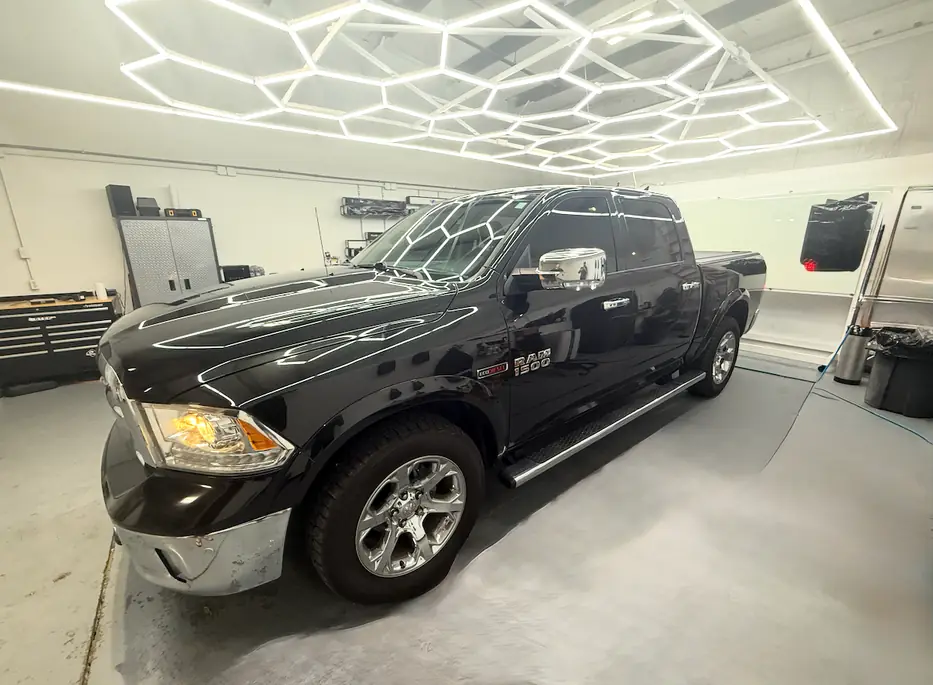
Black Ram 1500 under the hexagon ceiling lights
Lens surface first, protection second
Every job at DDM Services in Winter Springs starts with a look at the lens: how far the oxidation goes and whether there is surface damage to deal with. The lights are then cleaned so dirt and residue cannot get in the way of the correction.
The oxidised layer is removed with controlled sanding and polishing until the lens is clear, and then a protective treatment goes on to slow future UV damage. Skipping that last step is how a quick polish ends up hazy again within weeks, and it is the part we will not leave out.
Pricing is quoted per vehicle. Call (407) 337-5292 and tell us what you drive.
Chapter 03
Keeping the clarity once you have it
Restoration brings a lens back. Keeping it that way is a separate job, and clear paint protection film is the strongest answer. Every one of our PPF front packages includes the headlights, so the lens is shielded from stone chips and road grit as well as sun.
If a housing is cracked, restoration is not the right repair, and we will tell you so rather than polish over it. When the lens is sound, restoring it costs a fraction of replacing the assembly and makes a visible difference at night.
DDM Services, 1270 Belle Ave # 106, Winter Springs, FL. Open seven days, 8:00AM to 6:00PM. Call (407) 337-5292.
Five checks before you call
Signs your headlights are due.
You can run this check in your driveway. If two or more sound like your car, a quote is worth the call.
- A yellow or amber cast
- The lens has oxidised. Sun and heat break down the outer surface, and the plastic stops being clear.
- Haze that wiping will not clear
- If a wash leaves the fog in place, the damage is in the lens surface, not on top of it.
- A short, dim beam at night
- A cloudy lens scatters light instead of sending it down the road, so the pool of light in front of you shrinks.
- Extra glare in rain or fog
- Scattered light bounces back at you and at oncoming drivers, and wet roads make it worse.
- One side clearer than the other
- Lenses rarely age at the same pace. Compare the two from a few steps back in daylight.
After the lens is restored, front-end film is how you keep it clear. Cracked housing instead of cloudy lens? That one needs a replacement, not a polish.
Straight answers
Headlight restoration questions.
How long does headlight restoration last?
Done properly and protected afterward, a restoration can hold up for years. How long depends on how much sun the car sees, how it is driven and how it is kept. The protective step exists to slow the next round of oxidation.
Is restoring better than replacing the headlights?
In most cases, yes. Restoration brings back clarity and light output for far less than a new assembly, which on newer cars can be a costly integrated unit. The exception is a housing that is cracked or badly damaged, where restoring the lens will not fix the real problem.
Will I notice better night visibility right away?
Yes. Once the lens can pass light again, the beam is brighter and better focused, which you will see on a dark road and in poor weather.